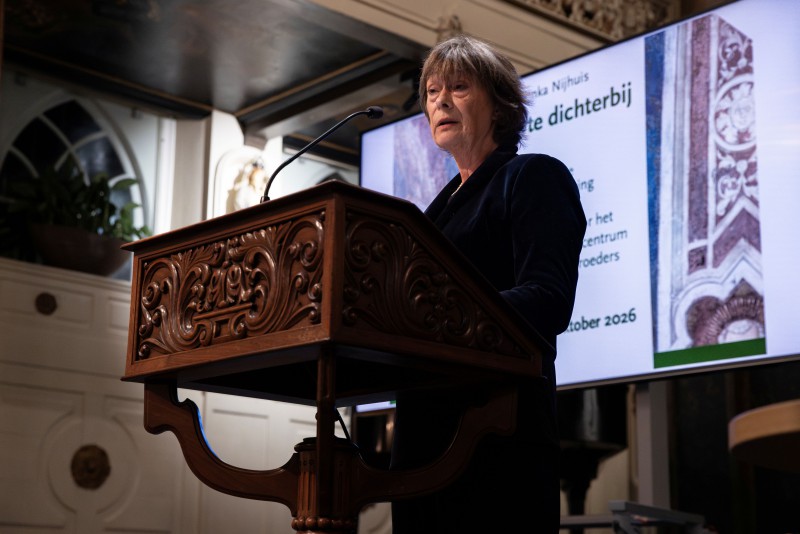
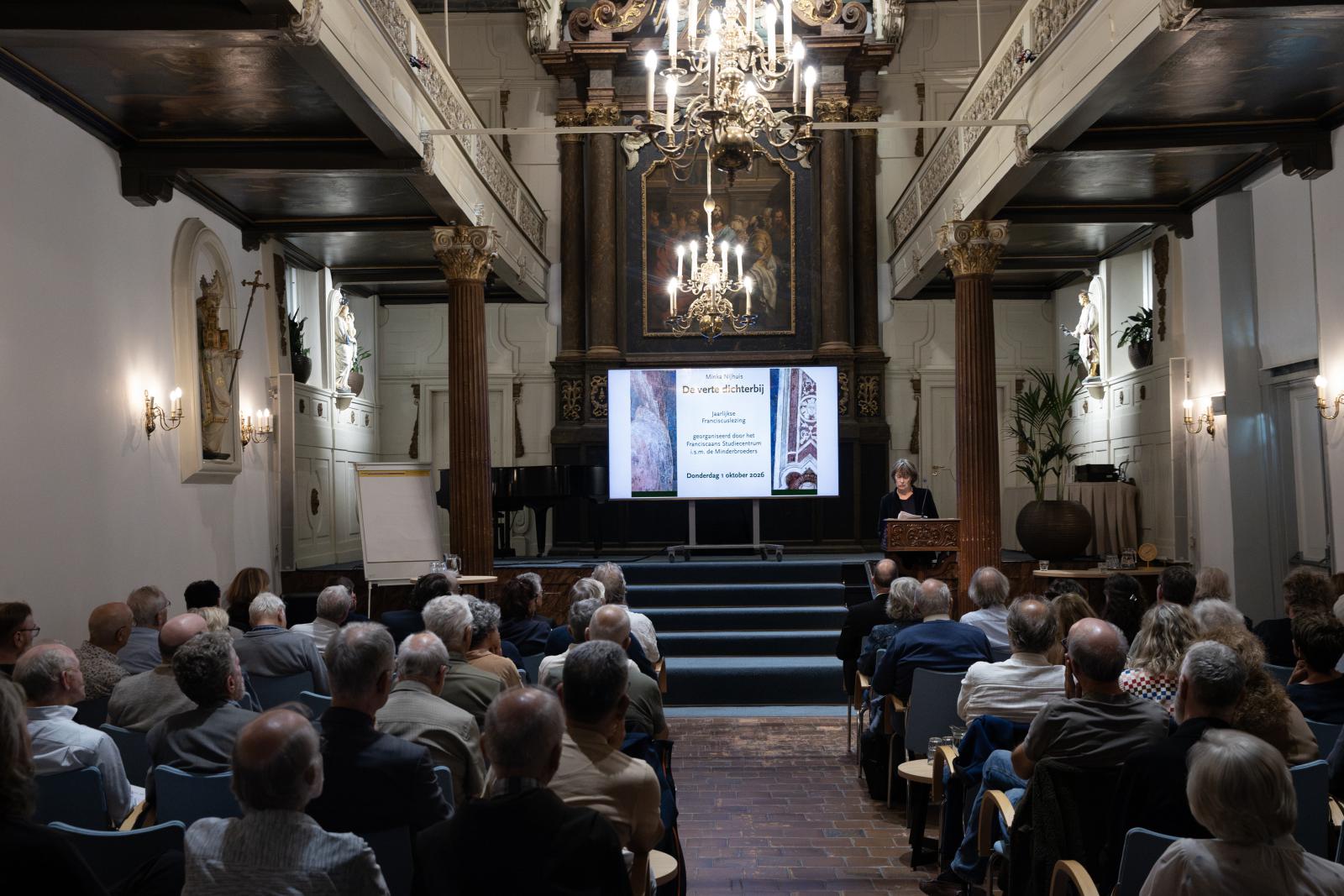
First Francis Lecture: "Bringing the Faraway Closer" (in Dutch) by war journalist Minka Nijhuis (Thursday, October 1, 2026, Utrecht).
Hope is the thing with feathers
That perches in the soul
And sings the tune without the words
And never stops at all
Emily Dickinson
It was April 2003 when I met Sawsan in Baghdad. After the U.S. invasion and the fall of Saddam Hussein’s regime, the city was still a dangerous mix of fighting and marauding gangs. Yet a play was being performed at the Rashid Theater. It was the first free performance in decades. In just a few days, a group of about thirty-five young actors had prepared the performance by the light of flashlights. They called themselves Nadjien, the survivors.
The cultural group had been founded about ten years earlier. In the utmost secrecy, they had occasionally presented poems and plays; this was their first public performance. The theater had sustained severe damage during the war. Afterward, it had been ruthlessly looted. The audience made their way inside over shards of glass, bullet casings, and the debris of a collapsed ceiling.
Few Iraqis dared to venture outside in those days, but despite that, the dark, sweltering auditorium was nearly full. The stage was still littered with destroyed props: curled-up film reels and broken scaffolding with shattered lighting fixtures. A cluster of army helmets served as decoration. During the performance, you could hear looters continuing their activities at the rear of the building. At night, the actors took turns sleeping inside the building with a rifle to protect it from thieves and squatters. One of them said there was still a corpse lying under the rubble.
It was a chaotic, experimental play, and I’m sure I wasn’t the only one who didn’t understand much of the intended symbolism. But that wasn’t the point. For the first time, the residents of Baghdad saw their recent history of dictatorship portrayed without censorship in one of their own theaters. Many let their tears flow freely.
In the audience, I ran into Sawsan with her husband and friends. She was a striking figure, with expressive eyes in a face framed by short, shiny hair. She spoke up immediately when I asked what the performance meant to her. “I felt human again,” she said.
She and her husband, Fadhil, then drove me through Baghdad. President George W. Bush had declared on an aircraft carrier that hostilities had ended. Many news reports also expressed optimism. Sawsan reacted with skepticism: “This is far from over.” It was because of those words that I moved in with Sawsan’s small household—her husband and her elderly mother, Khala—to document their daily lives as closely as possible.
Under the American administration, which was based in one of Saddam’s former palaces, their familiar city gradually became a maze of concrete walls, blocked thoroughfares, and checkpoints. A ten-minute drive to run errands or visit friends could easily turn into hours. During the day, temperatures reached fifty degrees, and there was no electricity for a fan or air conditioning.
The daily violence brought uncertainty about the fate of loved ones if they didn’t come home before dark. Some never came home at all. One day, visibly shaken, Sawsan told me about little Ahmed, who already understood so much about the destructive power of bombs that he had written on his limbs: “This leg belongs to Ahmed. This arm belongs to Ahmed.”
I was no longer a novice in the field when I settled in that neighborhood in Baghdad. In previous years, I had reported on conflicts in Myanmar, Cambodia, East Timor, and Afghanistan, among other places. But never before had I learned so much in such a short time about daily life in war. And about the art of survival. When the roar of helicopters made sleep impossible, Sawsan would tune the radio for her mother to a program that aired listeners’ love stories. One night, after bombs exploded so close by that the windows shattered inward and her mother woke up startled, covered in shards of glass, Sawsan picked a gardenia to serve with breakfast so that its sweet scent would chase away the fear and gloom. To keep our spirits up, the three of us would sometimes sit on the big couch in the living room, drinking apple juice from elegant glasses and pretending it was champagne.
Never before had I witnessed firsthand just how wide the gap was becoming between media reports and daily life in the city. For a while longer, the news was dominated by discussions about a constitution for the new Iraq that the Americans had promised, but Iraqi militias and death squads were appearing on the streets with increasing frequency. Kidnappings were the order of the day. Conflicts were brewing between the old and new powers, tensions between Shiites and Sunnis were flaring up—with neighboring countries actively stoking the flames—and old personal scores were settled all too easily in a lawless country teeming with weapons.
By the time the war erupted in full force, the world’s attention had already largely waned. Virtually only major bombings made the news. The smaller, daily incidents that startled the Sawsan household had long since ceased to matter. The crucial fact that all this calamity had been preceded by an invasion based on falsehoods about weapons of mass destruction—an operation that the Netherlands had also supported politically—faded from international memory, only to resurface on rare occasions. The people of Iraq and millions of other citizens in the region did, however, retain the impression that international law was applied selectively when it suited the situation. These are deep grievances that linger to this very day.
As a girl, Sawsan had dreamed of visiting America, the country her father spoke of with such affection. He had been the first Iraqi to earn a PhD there and had lived with a warm and welcoming host family. For years afterward, Christmas cards continued to be exchanged between the two families. Eventually, driven by all the violence, Sawsan and her mother were forced to do what they had refused to do even during the darkest years of the dictatorship. They left their country. Because Sawsan had worked for the American coalition for some time, their asylum application led them to Baltimore.
No sooner had she arrived than she warned that freedom and democracy should never be taken for granted. When the U.S. fell under the grip of President Trump and their ilk, she spoke about it with equal parts keen observation and fearless calm. Not succumbing to despondency, despair, or fear; remaining level-headed and humane; not viewing neighbors and others as enemies—these were her acts of resistance. She had practiced them in the same way years earlier, in the privacy of her home in Baghdad—first under Saddam’s regime and then during the war. They could not break her.
Under pressure from the free market, viewership, and circulation figures, journalists are increasingly expected to make their mark. The war correspondent is no longer supposed to be a modest witness who puts the story first, but a storyteller who takes center stage. Images of a helmet, flak jacket, or burqa serve as selling points. Whether appropriate or not, the phrase “at the risk of one’s own life” is thrown in as extra publicity. Superlatives run rampant.
“But the public also wants to know more about our man or woman on the ground,” goes the argument. And: “That personal approach draws people into the story.” I have my doubts about that. Anyone who looks at social media, where there’s a lot of interaction between the media and the public, will mainly see comments along the lines of: “How brave of you to be there.” “Are you taking good care of yourself?” “Glad you’re home again.” And much less often: “What a compelling story you told.” Or: “I’ve learned a lot from your reports.”
I still believe that deep down, most of us would rather not take center stage in our reporting or in programs that pander to cheap heroism. After all, our reporting on war is done of our own free will, with a return ticket in hand and the knowledge that our loved ones are safe. That cannot be compared to the work of local journalists and media workers for whom war is not only the subject of their reports but also their home. Virtually all of us know the discomfort—or even the shame—of leaving them behind in war zones.
So let my story above all be a plea for how this beautiful and important profession can be improved—more carefully, more humanely, more poignantly—to offer a view beyond our own borders. Especially in times when there are calls to close those borders far too ruthlessly. Journalism that shows us a world of which we are a part, whether we like it or not. That is not an easy answer, but it is by far the best response to hostility, populism, stigmatization, and manipulated fears.
This is an abridged version of the Franciscus Lecture delivered by Minka Nijhuis on Thursday, October 1, in Tilburg, at the initiative of the university’s Franciscan Study Center, in collaboration with the Friars Minor. See the book (in Dutch) here: https://openpress.tilburguniversity.edu/projects/de-verte-dichterbij
Minka Nijhuis is a freelance journalist and author; she works primarily in conflict zones, including Syria, Iraq, Afghanistan, Burma (Myanmar), and other countries in Southeast Asia.
.jpg)