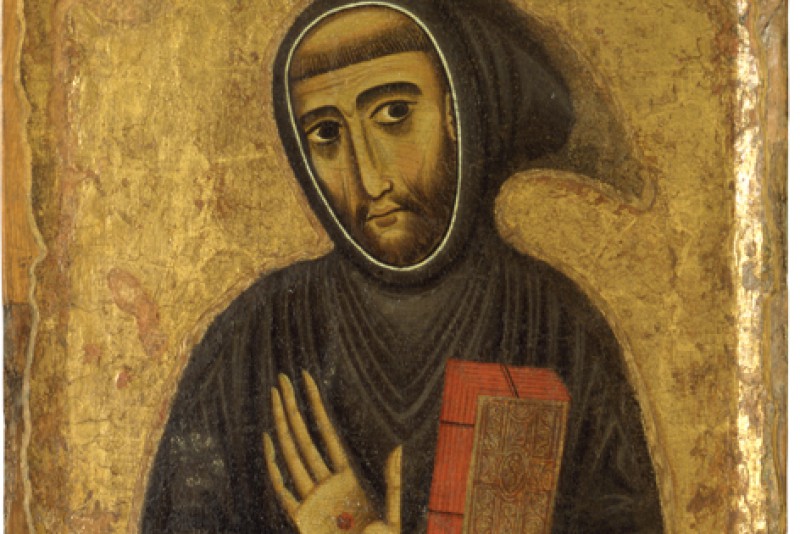
Anthony M. Carrozzo, OFM., "Discovering the Word Within"
When I was a young altar boy I remember that the Mass did not really end with the final blessing; rather it ended with what we traditionally called the Last Gospel which is the first chapter of St. John's Gospel. There we are reminded that Word was made flesh and dwelt among us. It is a challenging statement because it reminds us that prior to all the written scriptures which came some four hundred years later, along with our present day studies of those scriptures, the place where we find the Word is in flesh of the Word of God made man. This was astonishing even to our brilliant and sainted Bonaventure who saw that even the simplest woman who is incapable of reading may still possess a greater understanding of the Word of God than he with all of his education and subsequent knowledge. Bonaventure thus indicates that this woman’s insight is profound. In her the Word is made flesh. Flesh then is not our enemy. It is part of our relationship with the Word.
Francis himself acknowledged this at the end of his life by apologizing to his flesh for the way in which he treated it but I suspect he even missed the point that if we want to discover the Word we begin by looking at our own flesh as well as in the flesh of all of God’s creatures large and small who come alive again when we discover what it means that we live in the Word. That is what John is saying to us: if the Word was made flesh and the Word dwells among us, Jesus is the text that we must learn to read, the text that we must absorb within ourselves and all creatures with whom we share the universe, even in the dust and dirt that we will become.
Recall the wonderful words of the priest and poet John Dunne:
If I were merely dust and ashes, I might speak unto the Lord for the Lord's hand made me of this dust and the Lord's hand shall recollect these ashes the Lord's hand was the wheel upon which this vessel of day was framed and the Lord's hand is the urn in which these ashes shall be preserved. I am the dust and the ashes of the temple of the Holy Spirit, and what marvel is so precious? But I am more than dust and ashes: I am my best part, I am my soul.
Flesh speaks to flesh, dust speaks to dust, soul speaks to soul, and since the Word dwells among us, we need only to look around at our dwelling places to discover the Word made flesh. Or to put it in the unforgettable words of scientist and theologian Ilia Delio: Matter matters to God, echoing Saint Bonaventure, who said that when the soul is released from the body at death, it still longs for a reunion of soul and body, which will take place after death. This gives us a much more appealing image of heaven than simply floating around for eternity; we return to fulfilled humanity, body and soul. This gives new meaning to Jesus’s saying that in my father’s house there are many mansions.
For Franciscans who profess to live the Gospel, there are profound repercussions. The gospels are no longer simply four books written by four disciples. They are the Gospel written on our hearts. Since books of the New Testament are produced very inexpensively and found almost everywhere, even in hotel rooms and other public places, we may fail to have respect for the written word of God, but then we recall the inclination of Francis as he traveled the hills and towns of Umbria; he stopped when he saw small pieces of the scriptures tossed aside and picked them up as if they were Eucharist itself. He knew that these words spoke to him the words from God; he also knew that deeply within his heart God was speaking to him and leading him in new ways and new direction. It happens with us. This makes us different from the early Christians who, not having the four written Gospels to depend upon, found the gospel in their hearts and in the narratives that they shared with one another. They did not have the four gospels until four hundred years later. We have them tucked under our arms and so we may easily forget that we also have the gospel in our hearts. It is there that we find the Word to reflect upon; the Word becomes flesh within us, around us.
The Word is made flesh and dwells within us. This is the foundation of our hope. Yet the greatest enemy of hope is fear which paralyzes us and leads us to believe that there is nothing that we can do about our life, our problems, our relationship with God. When we fear we feel that we have no reason to be hopeful. Hope must not only be placed in belief that the presence of God will be in our lives, but also in belief that we are able to do something about our lives. Because of the relationship that exists for us with God we have a choice, a simple choice: to live in fear that paralyzes us or to overcome fear so that we can become hopeful people again, hoping not in a resurrection of the past, but in the resurrection of new life in the future that we have yet even to imagine: the kingdom of God which will arrive one day in its fullness.
The Irish poet Michael Coady expresses these contrasting views in a poem:
Though there are torturers in the world
there are also musicians
Though, at the moment, men are screaming in prisons
There are jazzmen raising storms
Of sensuous celebration
glorious rehearsing of the Spirit.
Though the image of God
Is everywhere defiled
A man in West Clare Is playing the concertina
The Sistine choir is levitating
Under the dome of Saint Peter’s
And a drunk man on the road
is singing for no reason.
The choice is ours. Do we wish to be torturers or musicians? Prisoners or jazz persons? Defiling God‘s image or celebrating His image? Levitating or simply getting drunk? Perhaps in our daily lives, we are confused because we are a combination of all of these. Therefore it is necessary for us to look deeply into our hearts, into our spirits, into our minds to discover the simple revelation that is there: the truth of God’s loving presence, and that is enough for us.